
How British Companies Can Use Bahrain as a Gateway to GCC Markets
Are you planning Gulf expansion but unsure where to register, hire, bank, and begin trading?
The GCC offers strong commercial opportunities, but each country follows its own licensing, tax, employment, ownership, and regulatory rules. Therefore, choosing the right first market requires more than simply registering a company. Founders need a structure that connects trade, finance, people, contracts, and compliance.
For UK entrepreneurs entering Bahrain, the country can provide a practical starting point for building relationships and exploring opportunities across the wider Gulf. At Jitendra Consulting Group, we help founders assess the right market-entry and company-formation route before they commit capital.
What the Concluded UK-GCC Free Trade Agreement Means for British Businesses
The United Kingdom and the Gulf Cooperation Council concluded negotiations on a free trade agreement on 20 May 2026. However, the agreement is not yet in force. The UK and all six GCC member states must complete their respective domestic procedures before businesses can trade under its terms.
This distinction matters. British founders should prepare for the agreement’s expected opportunities, but they should not assume that its tariff, customs, services, or digital-trade provisions are already available.
Once the agreement enters into force and is implemented, it is expected to:
- reduce tariffs on eligible British exports;
- improve market-access certainty for service providers;
- support digital trade and technology partnerships;
- strengthen regulatory cooperation;
- provide more accessible trade information for SMEs; and
- encourage investment between the UK and GCC markets.
The concluded agreement is expected to remove tariffs on approximately 93% of UK exports to the GCC. The UK government estimates that this could remove around £580 million in duties annually based on current trade, with approximately £360 million of those estimated duties removed when the agreement enters into force.
Until that happens, British companies must continue operating under the existing trade, customs, licensing, and regulatory frameworks.
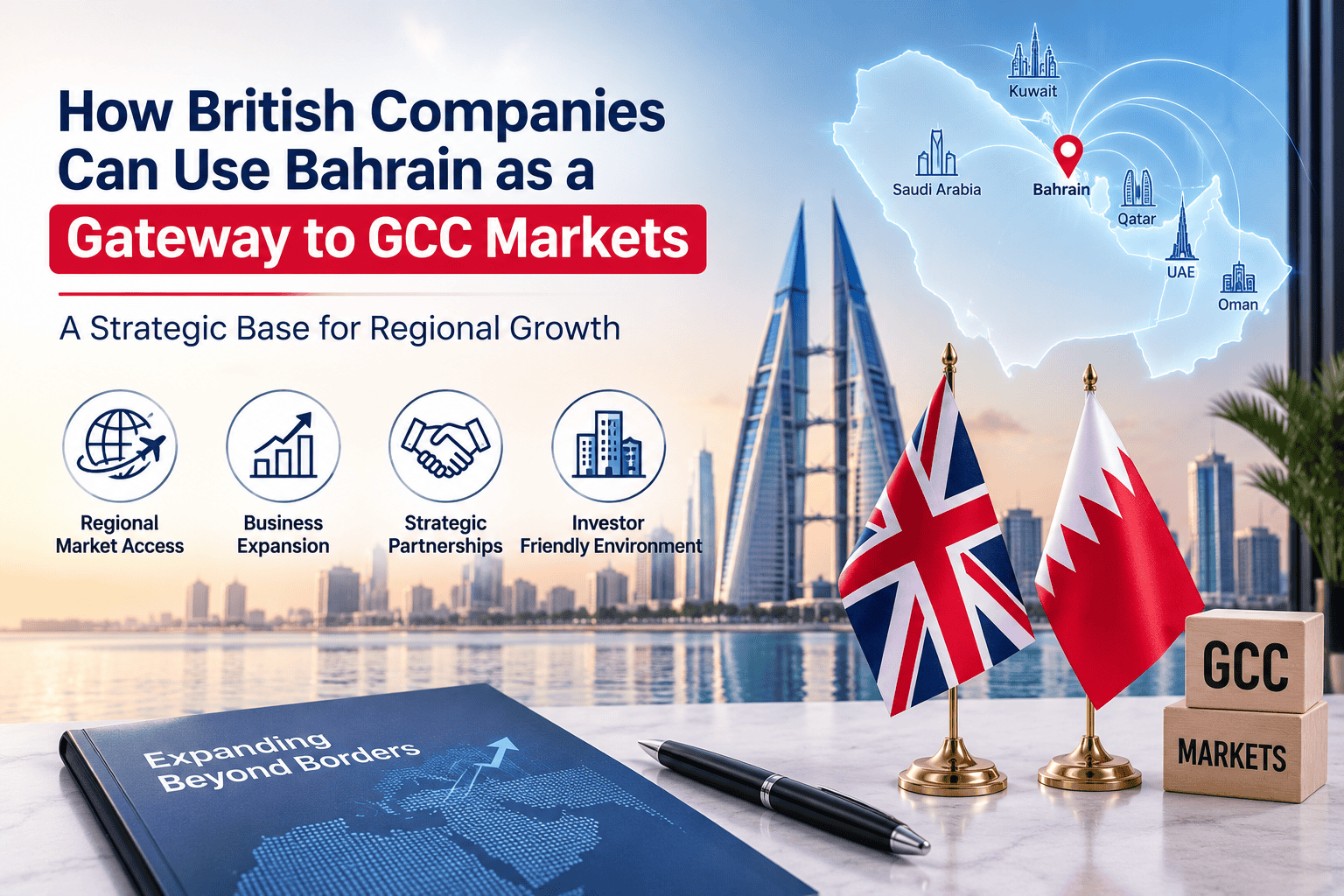
Why Bahrain Is Emerging as a UK Business Gateway to the GCC
Bahrain offers a compact commercial environment with established financial institutions and access to regional partners, advisers, regulators, and logistics providers. It also permits 100% foreign ownership in most business sectors, subject to the selected activity and applicable regulations.
The trade relationship between Bahrain and the UK also continues to develop. Total trade in goods and services reached £1.3 billion during the four quarters ending Q4 2025. This represented a year-on-year increase of 25.1%, or £252 million.
During the same period:
- UK exports to Bahrain reached approximately £1 billion;
- UK imports from Bahrain reached £238 million;
- UK goods exports to Bahrain increased by 42.7%; and
- UK service exports to Bahrain increased by 15.7%.
The stock of UK foreign direct investment in Bahrain also reached £105 million at the end of 2024, representing an increase of 31.3% from the previous year.
These figures do not automatically make Bahrain suitable for every UK business. However, they demonstrate an active commercial relationship that British founders can assess when planning Gulf expansion.
How British Founders Can Use Bahrain for Regional Market Entry
A Bahrain-registered company can support local sales, recruitment, invoicing, banking, contracting, and partner development. However, registering in Bahrain does not automatically give a company the right to operate in every GCC country.
Each target market may still require its own:
- commercial licence;
- tax registration;
- customs registration;
- product approval;
- professional authorisation;
- local distributor;
- branch or subsidiary; or
- employment and immigration registration.
Therefore, using Bahrain as a gateway to GCC markets works best through staged expansion.
A British founder may begin with a clearly defined activity, a small operating team, and selected Bahrain-based clients or partners. After testing demand, the business can consider entering other GCC markets through distributors, commercial agencies, branches, subsidiaries, or strategic partnerships.
This approach can protect working capital while giving the company time to understand regional customer expectations.
Potential UK-GCC Trade Benefits for Companies Expanding Through Bahrain
The concluded trade agreement can support a wider regional business plan once it enters into force. However, the actual benefit available to a company will depend on its products, services, origin documentation, operating structure, and target markets.
Reduced tariffs on eligible goods
British exporters may benefit from reduced or eliminated customs duties on qualifying products. However, goods will need to satisfy the relevant rules of origin and customs requirements.
Simply exporting a product from the UK will not always be enough. Businesses may need to demonstrate where materials were sourced, where manufacturing took place, and how the product qualifies for preferential treatment.
Greater certainty for service providers
The agreement is intended to give service businesses greater certainty when entering GCC markets. This could support British companies operating in areas such as consulting, engineering, technology, financial services, education, healthcare, and other professional sectors.
Nevertheless, regulated activities will continue to require the necessary local licences and approvals.
Support for digital trade
Technology and online businesses may benefit from the agreement’s focus on digital trade, innovation, cybersecurity, and cross-border commercial activity.
However, software and digital-service providers must still consider local rules covering data, privacy, consumer protection, cybersecurity, electronic transactions, and regulated content.
Dedicated support for SMEs
The agreement includes a dedicated SME chapter intended to improve access to trade information and make international expansion more manageable for smaller businesses.
This could help founders understand procedures and market requirements more easily after the agreement becomes effective.
Company Formation Options for British Entrepreneurs in Bahrain
The appropriate legal structure depends on the company’s activities, ownership plan, funding requirements, staffing model, and intended markets.
For example, a consulting business may need a different licence from a trading, technology, manufacturing, or regulated financial-services company. A founder planning to raise external investment may also need stronger shareholder protections and governance documents from the beginning.
Business setup in Bahrain generally includes:
- selecting the commercial activity;
- determining the appropriate legal form;
- checking foreign-ownership eligibility;
- reserving the company name;
- preparing constitutional and shareholder documents;
- securing an appropriate business address;
- applying for commercial registration;
- obtaining sector-specific approvals; and
- maintaining the required company records.
After registration, the company may also need to arrange:
- corporate banking;
- labour and immigration registration;
- employee visas;
- tax registration;
- accounting systems;
- beneficial-ownership records;
- payroll processes; and
- annual compliance and renewals.
Completing the commercial registration is only one stage of entering the market. The structure must also support the company’s planned revenue streams and operational needs.
Why British Founders Should Prepare Before the FTA Enters Into Force
The agreement has been concluded, but its terms are not yet available for businesses to use. This preparation period gives UK companies time to review their GCC expansion strategy before the agreement becomes effective.
Founders can use this period to:
- identify suitable GCC markets;
- compare Bahrain with other regional jurisdictions;
- review product classifications and rules of origin;
- assess local licensing requirements;
- prepare contracts and compliance systems;
- identify distributors or commercial partners;
- plan tax and customs processes; and
- determine whether a Bahrain entity fits the wider regional model.
Establishing a company before the FTA enters into force will not automatically give it preferential treatment. However, early preparation may place the business in a stronger position to use the agreement after ratification and implementation.
How Jitendra Consulting Group Supports Bahrain Market Entry
A sound Bahrain entry plan should connect company formation with licensing, ownership, tax, banking, employment, accounting, and ongoing compliance.
Jitendra Consulting Group supports British founders, SMEs, and corporate investors by reviewing the proposed activity, ownership structure, licence route, office requirements, and regulatory obligations.
For regulated or specialised activities, we can help investors understand the approval route and prepare the required documentation in coordination with the relevant local professionals and authorities.
The UK-GCC Free Trade Agreement has created a clear signal of closer economic cooperation, but the agreement is not yet operational. British founders should use this period to prepare carefully, select the right regional base, and build a structure that can support both Bahrain operations and future GCC expansion.
 English
  Arabic